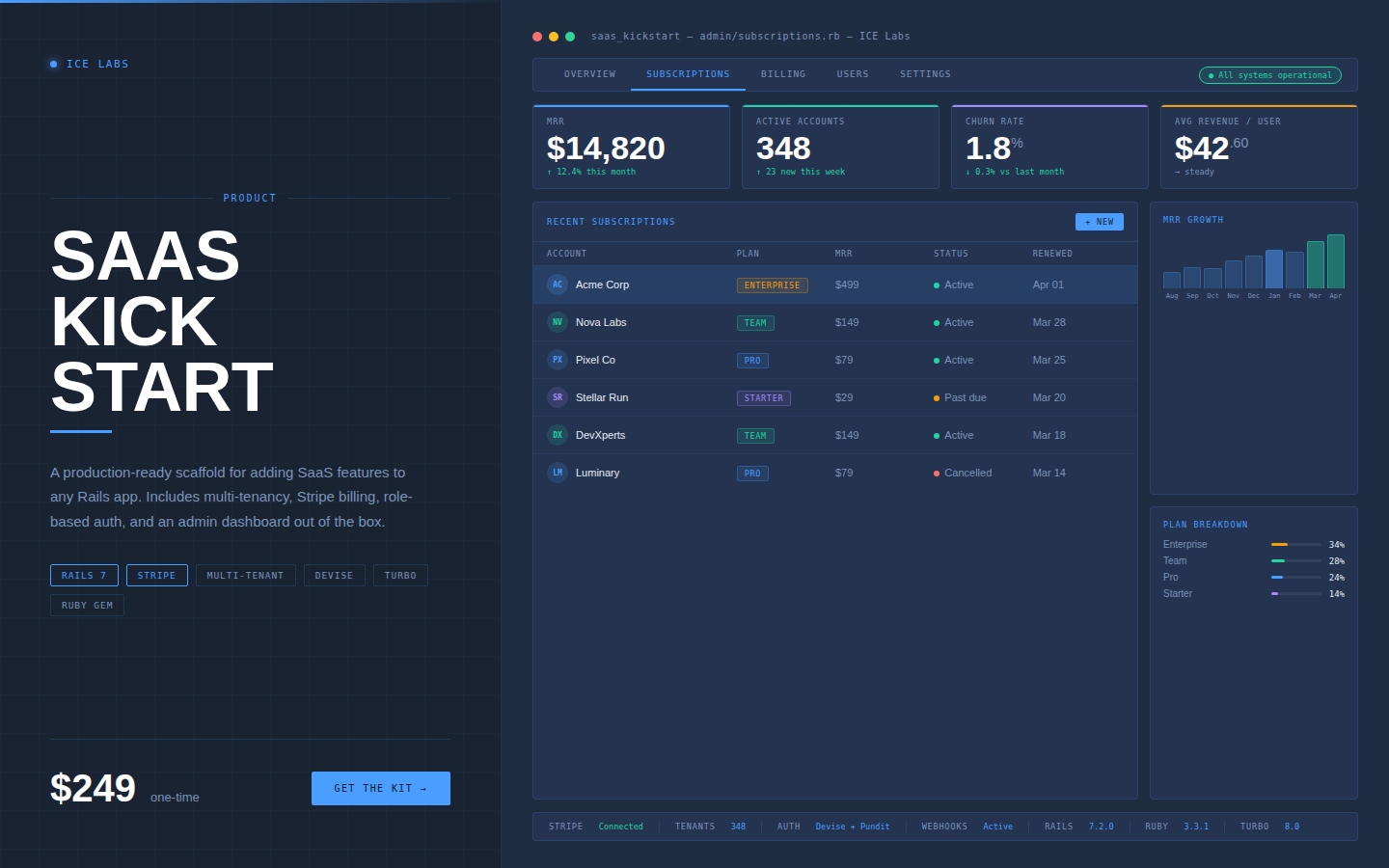
What Is It?
The SaaS Kick Start Template is a production-ready scaffold that wires Retrieval-Augmented Generation directly into your Rails application — no glue code required. It ships with a vector store adapter layer, an embedding pipeline backed by OpenAI or Ollama, and a clean query interface you can drop into any controller or background job.
Built from real-world experience integrating LLMs into healthcare and SaaS backends, this kit is designed to be boring in the best possible way: plain Ruby objects, standard Rails conventions, and zero magic that breaks when you upgrade.
Stop wrestling with Python microservices. RAG belongs in your Rails monolith.
Who Is It For?
This kit is aimed squarely at Rails engineers who:
- Want to add semantic search or document Q&A to an existing app without spinning up a separate Python service
- Need to embed internal knowledge bases, support docs, or structured records into an LLM context window
- Are evaluating RAG approaches and want a reference implementation that follows Rails idioms
- Have tried LangChain or LlamaIndex and found them overpowered for a focused Rails use case
What’s Included
1. Vector Store Adapter
A thin adapter layer over pgvector (PostgreSQL extension) so your embeddings
live right alongside your existing data. Swap to Pinecone or Qdrant by changing a single
initialiser line — no model changes required.
2. Embedding Pipeline
A Rag::EmbeddingJob Active Job class that chunks, cleans, and embeds your
documents on creation or update. Supports text-embedding-3-small (OpenAI) and
nomic-embed-text (Ollama) out of the box.
# Embed a document on creation
class Article < ApplicationRecord
  after_save :embed_content, if: :saved_change_to_body?

  private

  def embed_content
    Rag::EmbeddingJob.perform_later(self)
  end
end
3. Query Interface
A Rag::Query service object that takes a natural-language question, retrieves
the top-k relevant chunks via cosine similarity, assembles a context window, and
streams a completion back from the LLM of your choice.
result = Rag::Query.ask(
  question: "What is our refund policy?",
  scope:    Article.published,
  top_k:    5
)

puts result.answer      # LLM-generated response
puts result.sources     # Array of matched Article records
4. Rails Engine & Mountable Dashboard
Mount the included engine to get a read-only dashboard showing embedded document counts, query logs, latency metrics, and embedding coverage — useful during development and QA.
# config/routes.rb
mount Rag::Engine, at: "/rag/dashboard"
Quick Start
Installation
# Gemfile
gem "rag-rails"
bundle install
rails rag:install
rails db:migrate
Configuration
# config/initializers/rag.rb
Rag.configure do |config|
  config.embedding_provider = :openai          # or :ollama
  config.vector_store        = :pgvector        # or :pinecone, :qdrant
  config.openai_api_key      = ENV["OPENAI_API_KEY"]
  config.chunk_size          = 512              # tokens per chunk
  config.chunk_overlap       = 64
end
Compatibility
| Dependency | Version | Notes |
|---|---|---|
| Ruby | 3.1+ | Tested on 3.1, 3.2, 3.3 |
| Rails | 7.0+ | Including Rails 8 |
| PostgreSQL | 14+ | Requires pgvector extension |
| OpenAI API | — | Optional — Ollama supported |
Roadmap
- Multi-modal embeddings (image + text)
- Streaming responses via Hotwire Turbo Streams
- Hybrid BM25 + vector search
- LangGraph-style agent loop integration
License
Released under the MIT License. Free to use in commercial and open-source projects. Contributions welcome via GitHub pull requests.